
171 lines
6.5 KiB
Plaintext
171 lines
6.5 KiB
Plaintext
Metadata-Version: 2.1
|
||
Name: tiktoken
|
||
Version: 0.8.0
|
||
Summary: tiktoken is a fast BPE tokeniser for use with OpenAI's models
|
||
Author: Shantanu Jain
|
||
Author-email: shantanu@openai.com
|
||
License: MIT License
|
||
|
||
Copyright (c) 2022 OpenAI, Shantanu Jain
|
||
|
||
Permission is hereby granted, free of charge, to any person obtaining a copy
|
||
of this software and associated documentation files (the "Software"), to deal
|
||
in the Software without restriction, including without limitation the rights
|
||
to use, copy, modify, merge, publish, distribute, sublicense, and/or sell
|
||
copies of the Software, and to permit persons to whom the Software is
|
||
furnished to do so, subject to the following conditions:
|
||
|
||
The above copyright notice and this permission notice shall be included in all
|
||
copies or substantial portions of the Software.
|
||
|
||
THE SOFTWARE IS PROVIDED "AS IS", WITHOUT WARRANTY OF ANY KIND, EXPRESS OR
|
||
IMPLIED, INCLUDING BUT NOT LIMITED TO THE WARRANTIES OF MERCHANTABILITY,
|
||
FITNESS FOR A PARTICULAR PURPOSE AND NONINFRINGEMENT. IN NO EVENT SHALL THE
|
||
AUTHORS OR COPYRIGHT HOLDERS BE LIABLE FOR ANY CLAIM, DAMAGES OR OTHER
|
||
LIABILITY, WHETHER IN AN ACTION OF CONTRACT, TORT OR OTHERWISE, ARISING FROM,
|
||
OUT OF OR IN CONNECTION WITH THE SOFTWARE OR THE USE OR OTHER DEALINGS IN THE
|
||
SOFTWARE.
|
||
|
||
Project-URL: homepage, https://github.com/openai/tiktoken
|
||
Project-URL: repository, https://github.com/openai/tiktoken
|
||
Project-URL: changelog, https://github.com/openai/tiktoken/blob/main/CHANGELOG.md
|
||
Requires-Python: >=3.9
|
||
Description-Content-Type: text/markdown
|
||
License-File: LICENSE
|
||
Requires-Dist: regex>=2022.1.18
|
||
Requires-Dist: requests>=2.26.0
|
||
Provides-Extra: blobfile
|
||
Requires-Dist: blobfile>=2; extra == "blobfile"
|
||
|
||
# ⏳ tiktoken
|
||
|
||
tiktoken is a fast [BPE](https://en.wikipedia.org/wiki/Byte_pair_encoding) tokeniser for use with
|
||
OpenAI's models.
|
||
|
||
```python
|
||
import tiktoken
|
||
enc = tiktoken.get_encoding("o200k_base")
|
||
assert enc.decode(enc.encode("hello world")) == "hello world"
|
||
|
||
# To get the tokeniser corresponding to a specific model in the OpenAI API:
|
||
enc = tiktoken.encoding_for_model("gpt-4o")
|
||
```
|
||
|
||
The open source version of `tiktoken` can be installed from PyPI:
|
||
```
|
||
pip install tiktoken
|
||
```
|
||
|
||
The tokeniser API is documented in `tiktoken/core.py`.
|
||
|
||
Example code using `tiktoken` can be found in the
|
||
[OpenAI Cookbook](https://github.com/openai/openai-cookbook/blob/main/examples/How_to_count_tokens_with_tiktoken.ipynb).
|
||
|
||
|
||
## Performance
|
||
|
||
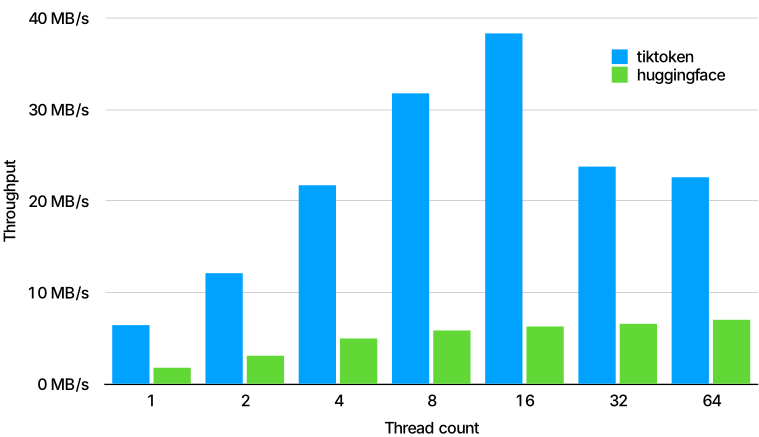
`tiktoken` is between 3-6x faster than a comparable open source tokeniser:
|
||
|
||
|
||
|
||
Performance measured on 1GB of text using the GPT-2 tokeniser, using `GPT2TokenizerFast` from
|
||
`tokenizers==0.13.2`, `transformers==4.24.0` and `tiktoken==0.2.0`.
|
||
|
||
|
||
## Getting help
|
||
|
||
Please post questions in the [issue tracker](https://github.com/openai/tiktoken/issues).
|
||
|
||
If you work at OpenAI, make sure to check the internal documentation or feel free to contact
|
||
@shantanu.
|
||
|
||
## What is BPE anyway?
|
||
|
||
Language models don't see text like you and I, instead they see a sequence of numbers (known as tokens).
|
||
Byte pair encoding (BPE) is a way of converting text into tokens. It has a couple desirable
|
||
properties:
|
||
1) It's reversible and lossless, so you can convert tokens back into the original text
|
||
2) It works on arbitrary text, even text that is not in the tokeniser's training data
|
||
3) It compresses the text: the token sequence is shorter than the bytes corresponding to the
|
||
original text. On average, in practice, each token corresponds to about 4 bytes.
|
||
4) It attempts to let the model see common subwords. For instance, "ing" is a common subword in
|
||
English, so BPE encodings will often split "encoding" into tokens like "encod" and "ing"
|
||
(instead of e.g. "enc" and "oding"). Because the model will then see the "ing" token again and
|
||
again in different contexts, it helps models generalise and better understand grammar.
|
||
|
||
`tiktoken` contains an educational submodule that is friendlier if you want to learn more about
|
||
the details of BPE, including code that helps visualise the BPE procedure:
|
||
```python
|
||
from tiktoken._educational import *
|
||
|
||
# Train a BPE tokeniser on a small amount of text
|
||
enc = train_simple_encoding()
|
||
|
||
# Visualise how the GPT-4 encoder encodes text
|
||
enc = SimpleBytePairEncoding.from_tiktoken("cl100k_base")
|
||
enc.encode("hello world aaaaaaaaaaaa")
|
||
```
|
||
|
||
|
||
## Extending tiktoken
|
||
|
||
You may wish to extend `tiktoken` to support new encodings. There are two ways to do this.
|
||
|
||
|
||
**Create your `Encoding` object exactly the way you want and simply pass it around.**
|
||
|
||
```python
|
||
cl100k_base = tiktoken.get_encoding("cl100k_base")
|
||
|
||
# In production, load the arguments directly instead of accessing private attributes
|
||
# See openai_public.py for examples of arguments for specific encodings
|
||
enc = tiktoken.Encoding(
|
||
# If you're changing the set of special tokens, make sure to use a different name
|
||
# It should be clear from the name what behaviour to expect.
|
||
name="cl100k_im",
|
||
pat_str=cl100k_base._pat_str,
|
||
mergeable_ranks=cl100k_base._mergeable_ranks,
|
||
special_tokens={
|
||
**cl100k_base._special_tokens,
|
||
"<|im_start|>": 100264,
|
||
"<|im_end|>": 100265,
|
||
}
|
||
)
|
||
```
|
||
|
||
**Use the `tiktoken_ext` plugin mechanism to register your `Encoding` objects with `tiktoken`.**
|
||
|
||
This is only useful if you need `tiktoken.get_encoding` to find your encoding, otherwise prefer
|
||
option 1.
|
||
|
||
To do this, you'll need to create a namespace package under `tiktoken_ext`.
|
||
|
||
Layout your project like this, making sure to omit the `tiktoken_ext/__init__.py` file:
|
||
```
|
||
my_tiktoken_extension
|
||
├── tiktoken_ext
|
||
│ └── my_encodings.py
|
||
└── setup.py
|
||
```
|
||
|
||
`my_encodings.py` should be a module that contains a variable named `ENCODING_CONSTRUCTORS`.
|
||
This is a dictionary from an encoding name to a function that takes no arguments and returns
|
||
arguments that can be passed to `tiktoken.Encoding` to construct that encoding. For an example, see
|
||
`tiktoken_ext/openai_public.py`. For precise details, see `tiktoken/registry.py`.
|
||
|
||
Your `setup.py` should look something like this:
|
||
```python
|
||
from setuptools import setup, find_namespace_packages
|
||
|
||
setup(
|
||
name="my_tiktoken_extension",
|
||
packages=find_namespace_packages(include=['tiktoken_ext*']),
|
||
install_requires=["tiktoken"],
|
||
...
|
||
)
|
||
```
|
||
|
||
Then simply `pip install ./my_tiktoken_extension` and you should be able to use your
|
||
custom encodings! Make sure **not** to use an editable install.
|
||
|